Optical and X Ray Polarized Scattering for Porous Nanoparticles and Aggregates such as Combustion Soot
mso-bidi-font-family: 'Times New Roman'; mso-bidi-font-family: 'Times New Roman'; mso-bidi-font-family: 'Times New Roman'; mso-bidi-font-family: 'Times New Roman'; mso-bidi-font-family: 'Times New Roman'; mso-bidi-font-family: 'Times New Roman'; mso-bidi-font-family:......
fra 1 649,-
På lager i 1 butikker
Kjøp på nett
Fjernlager
Frakt og levering
Sammenligning av produkter
Her finner du de fire mest populære produktene i denne kategorien i en lignende prisklasse som det du ser på nå.


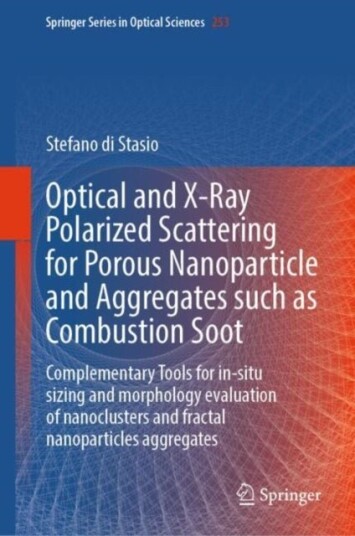
Optical and X Ray Polarized Scattering for Porous Nanoparticles and Aggregates such as Combustion Soot
1 649,-

Produktinformasjon
Scattering is one of the most powerful techniques for studying objects with size comparable to experimental radiation wavelength without necessity to sampling them, which is called in-situ characterization as opposed to the analysis of microsamples (ex-situ). Aggregates of nanoparticles are one of the most popular media in science and technology. Combustion, thermal decomposition, laser ablation, and plasma reactors are only a few of the methods used to generate particulates aggregated at the nanoscale. This book describes an ideal walk between scattering methods, experimental techniques, and numerical simulations applied to the study of nanoparticle aggregates. The first part of the book deals with laser light scattering at visible wavelengths. Different approaches using this method are presented, which allows us to gain information about nanoparticle aggregate size, number concentration and morphology without any a priori knowledge about the complex refractive indices of the constituent species. This is particularly relevant for strongly reacting environments in which the chemical composition and microstructure of the nanoparticles are continuously evolving, such as soot in flames. The second part of the book is focused on X-ray scattering. The main differences and analogies with respect to light scattering theory are presented. A general approach is introduced to present the quantities which can be measured in an experiment of Small-Angle X-ray Scattering (SAXS) on gas-phase generated aggregates of nanoparticles. Exemplary SAXS applications are introduced to show how the mechanisms of nucleation and aggregation of particles can be studied with a spatial resolution about two orders of magnitude smaller with respect to laser light scattering methods. The combined use of SAXS with other X-ray techniques, such as WAXS and NEXAFS is discussed. The complementary characters of light and X-ray scattering are emphasized by treating the topic of hierarchical nanoparticle aggregation.
Spesifikasjon
Produkt
| Produktnavn | Optical and X Ray Polarized Scattering for Porous Nanoparticles and Aggregates such as Combustion Soot |
| book typ | boker, dokumentar og fakta, historie og dokumentar, populaervitenskap |
Populære produkter
Pris og prishistorikk
Akkurat nå er 1 649,- den billigste prisen for Optical and X Ray Polarized Scattering for Porous Nanoparticles and Aggregates such as Combustion Soot blant 1 butikker hos Prisradar. Sjekk også vår topp 5-rangering av beste bøker for å være sikker på at du gjør det beste kjøpet.
Oscar JacobssonDrawing Protest Graphic Narratives for Youth and Social JusticeDrawing Protest Graphic Narratives for Youth and Social JusticeRobert Drew Interviews
Robert Drew InterviewsRebel Falls A NovelLivia and the Crooked TreeWon Ton A Cat Tale Told in Haiku (Anniversary Edition)
The ThousandYear Crusade for Palestine Zionist Christianity and the Settler JewThe Latent Brain The New Science of How We Think, Feel, and ActIs it Sunny on Saturn?Regionalism and Utopia The Speculative Radicalism of Local Color in the Long Gilded Age
Regionalism and Utopia The Speculative Radicalism of Local Color in the Long Gilded AgeA Doorless Knocking Into Night PoemsDebris Field PoemsDesigning Natural Ventilation Strategies Using Computational Fluid Dynamics A Guide for Architects
Designing Natural Ventilation Strategies Using Computational Fluid Dynamics A Guide for ArchitectsTell Tale A Wonderfully Dark and Comedic Murder Mystery with Unforgettable Characters at its HeartWinter Olympic Urbanism Comparative Studies in Regional DevelopmentDark Renaissance The Dangerous Times and Fatal Genius of Shakespeare's Greatest Rival