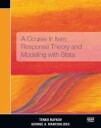
Raykov Tenko A Course in Item Response Theory and Modeling with Stata
Over the past several decades, item response theory (IRT) and item response modeling (IRM) have become increasingly popular in the behavioral, educational, social, business, marketing, clinical, and health sciences. In this book, Raykov and Marcoulides begin with a nontraditional approach to IRT and IRM that is based on their......
fra 699,-
På lager i 2 butikker
Kjøp på nett
Fjernlager
Frakt og levering
På lager
Frakt og levering
Sammenligning av produkter
Her finner du de fire mest populære produktene i denne kategorien i en lignende prisklasse som det du ser på nå.

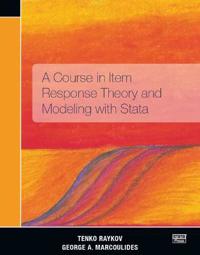
Raykov Tenko A Course in Item Response Theory and Modeling with Stata
699,-

Produktinformasjon
<P>Over the past several decades, item response theory (IRT) and item response modeling (IRM) have become increasingly popular in the behavioral, educational, social, business, marketing, clinical, and health sciences. In this book, Raykov and Marcoulides begin with a nontraditional approach to IRT and IRM that is based on their connections to classical test theory, (nonlinear) factor analysis, generalized linear modeling, and logistic regression. Application-oriented discussions follow next. These cover the one-, two-, and three-parameter logistic models, polytomous item response models (with nominal or ordinal items), item and test information functions, instrument construction and development, hybrid models, differential item functioning, and an introduction to multidimensional</P><P>IRT and IRM. The pertinent analytic and modeling capabilities of Stata are thoroughly discussed, highlighted, and illustrated on empirical examples from behavioral and social research.</P>
Topplisten: Stata Press Bøker
Spesifikasjon
Produkt
| Produktnavn | Raykov Tenko A Course in Item Response Theory and Modeling with Stata |
| Merke | Stata Press |
| book typ | boker, fagboker, matematikk og naturvitenskap, matematikk |
Populære produkter
Pris og prishistorikk
Akkurat nå er 699,- den billigste prisen for Raykov Tenko A Course in Item Response Theory and Modeling with Stata blant 2 butikker hos Prisradar. Sjekk også vår topp 5-rangering av beste bøker for å være sikker på at du gjør det beste kjøpet.