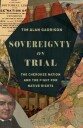
Sovereignty on Trial
The story of the legal battle between the Cherokee Nation and the State of Georgia that ultimately led to the infamous Trail of Tears and the ongoing struggles for Native sovereignty. Sovereignty on Trial tells the story of a trio of landmark United States Supreme Court casesJohnson v. MIntosh (1823), Cherokee Nation v. G......
fra 1 349,-
På lager i 1 butikker
Kjøp på nett
Fjernlager
Frakt og levering
Produktinformasjon
<p><b>The story of the legal battle between the Cherokee Nation and the State of Georgia that ultimately led to the infamous Trail of Tears and the ongoing struggles for Native sovereignty.</b></p><p></i>Sovereignty on Trial</i> tells the story of a trio of landmark United States Supreme Court cases—<i>Johnson v. M’Intosh</i> (1823), <i>Cherokee Nation v. Georgia</i> (1831), and <i>Worcester v. Georgia</i> (1832)—that considered the legal status of Native nations in the early nineteenth century.</p><p>Known as the Marshall Trilogy—majority opinions all written by Chief Justice John Marshall—the decisions are inconsistent in their holdings and reasoning, leaving American Indian law and interpretations of Native sovereignty confusing and ambiguous. In <i>M’Intosh</i>, Marshall used the imperial doctrine of discovery to diminish the property rights and autonomy of the Native nations. Subsequent interpretations of Marshall’s opinion in <i>Cherokee Nation</i>, with its “guardian and ward” analogy, ultimately placed Native people in a dependent status with the United States. At the end of his judicial career, however, Marshall came to view Native rights in a different light, and his opinion in <i>Worcester</i> was a powerful acclamation of Native political sovereignty and territorial rights. Courts have tried with little success to find a coherent line through the three rulings.</p><p>The two Georgia cases resulted from the state’s efforts to extend its jurisdiction over the Cherokee Nation and annihilate its government. These cases were decided against the backdrop of the Indian Removal Act of 1830. When President Andrew Jackson and Congress failed to enforce <i>Worcester</i>, Georgia interned and forcibly removed the Cherokee in the now infamous tragedy known as the Trail of Tears.</p><p>Tim Alan Garrison places this trio of cases in their broader legal and historical context. Significantly, Garrison explains why Georgia sought to expel the Cherokees from their homeland, how these attacks on native sovereignty tore apart Cherokee national unity, and how the changes in Cherokee political culture determined their strategy in resisting the state’s onslaught. The Cherokee resistance against Georgia was a remarkable example of national courage for the Indigenous peoples of the world, and their determination to fight oppression through the judicial system of the United States left a lasting impact on American Indian law. <i>The Cherokee Cases</i> tells an important, if disturbing, story whose reverberations are felt to the present day.</p>
Pris og prishistorikk for Sovereignty on Trial
Sovereignty on Trial koster 1 349 kr hos én butikk. Prisradar oppdaterte prisen sist 28. november 2026.
- Prisutvikling:
- Stabil
- Laveste pris:
- 1 349,-
- Gjennomsnittspris:
- 1 349,-
- Høyeste pris:
- 1 349,-
Prisen på Sovereignty on Trial har vært uendret på 1 349 kr siden 5. november 2026.
Grafen viser utviklingen i den laveste prisen blant butikkene som selger produktet. Fraktkostnader og brukte produkter er ikke inkludert.Slik samler Prisradar inn priser
Spesifikasjon
| Produkt | |
|---|---|
| Produktnavn | Sovereignty on Trial |
| book typ | boker, fagboker, samfunnsvitenskap |
FAQ
Black Friday er fredag 27. november 2026. Sammenlign prisen på Sovereignty on Trial hos flere butikker, og sjekk prishistorikken der den er tilgjengelig. Kontroller at tilbudene gjelder samme modell og variant, og ta med fraktkostnaden når du sammenligner.